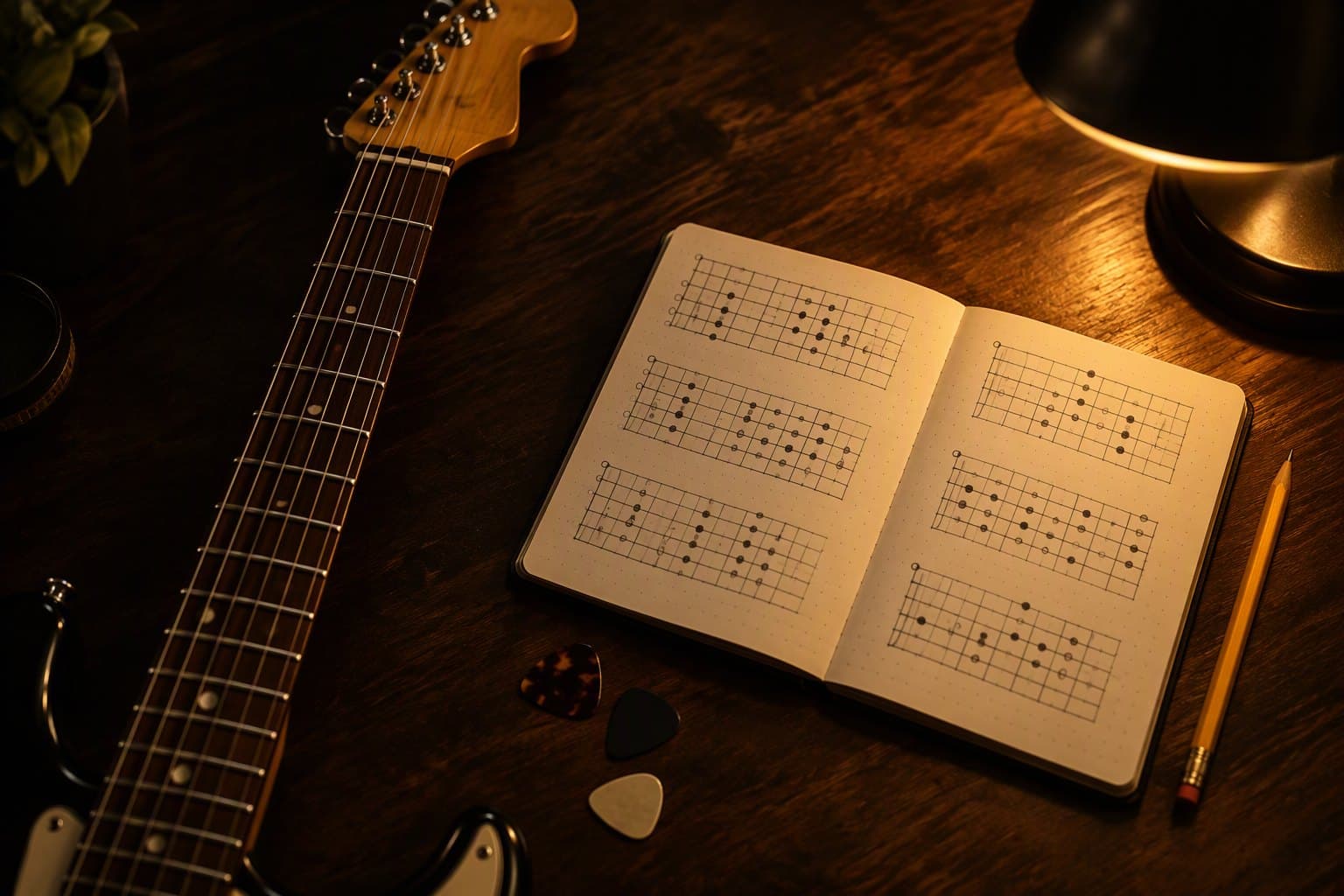
The major pentatonic is the major scale with two notes removed: the fourth and the seventh, the two that create tension. What's left is the root, second, third, fifth and sixth. In G major that's G A B D E.
With no tense notes, every note sounds good over a major chord. That's why it's all over country, southern rock, soul and pop solos.
The shape
Root G on the low E string at fret 3. Your hand sits in 2nd position, frets 2 to 5, two notes per string:
- Index finger on fret 2, middle on 3, ring on 4, pinky on 5.
- The roots are on the 3rd fret of the low E, the 5th fret of the D string and the 3rd fret of the high e.
- On the B string the notes sit at 3 and 5, one fret higher than on the G string.
Alternate pick in triplets, as with the minor pentatonic boxes.
It should sound bright, sweet and a little "open road". The phrase in the second exercise climbs to the fifth (D), passing the third (B), and settles back on the root.
The common mistake is ending phrases on random notes. Over a major chord, the root (G) and the third (B) sound like home. Aim for them at the end of each phrase.
Every position, practice drills and soloing ideas are in the Scale Library: Major Pentatonic Scale.