
For players ready to get serious
Practice with a plan.
Hear yourself improve.
Technique, theory and genre tracks from blues to jazz, in structured chapters. Every exercise comes with play-along audio and a tempo ladder. Start free, unlock everything with one payment.
- lessons
- 292
- exercises with audio
- 759
- practice plans
- 14
- free lessons
- 124
- languages
- 5
Try the player
Every exercise plays right in your browser. Press play, change the tempo and play along. No account needed.
A shuffle boogie
110 → 160 bpm- Bar 1
- A string, open + D string, fret 2
- A string, open + D string, fret 2
- A string, open + D string, fret 4
- A string, open + D string, fret 4
- A string, open + D string, fret 2
- A string, open + D string, fret 2
- A string, open + D string, fret 4
- A string, open + D string, fret 4
- Bar 2
- A string, open + D string, fret 2
- A string, open + D string, fret 2
- A string, open + D string, fret 4
- A string, open + D string, fret 4
- A string, open + D string, fret 2
- A string, open + D string, fret 2
- A string, open + D string, fret 4
- A string, open + D string, fret 4
How it works
01
Pick a chapter
Bends, shuffles, scales, theory: every chapter targets one skill.
02
Practice with the audio
Hear each exercise first, then play along with the click from the start tempo to the target tempo.
03
Pass the checkpoint
Advance when you pass the checkpoint, not when the week ends.
Who it's for
Beginners
You just picked up a guitar. Start with Foundations: reading tab, first chords and a steady picking hand.
Self-taught players who feel stuck
You know some chords and the pentatonic box but practice without direction. Plans and checkpoints give you a path.
Genre explorers
Blues, rock, metal, funk, country, jazz and fingerstyle tracks, plus guides to play like the legends.
Tone tinkerers
Learn what each pedal does, how to order a pedalboard and how famous tones were built.
Not for you if you want video lessons or a live teacher: Tubeglow is tab, text and play-along audio.
Start free
Hand-picked lessons and guides you can open right now. No card needed.
 Free
FreeFirst Steps
Reading tab
Tab shows where to put your fingers, not which notes they are. Six lines, one per string: the top line is the high e string, the bottom line is the low…
 Free
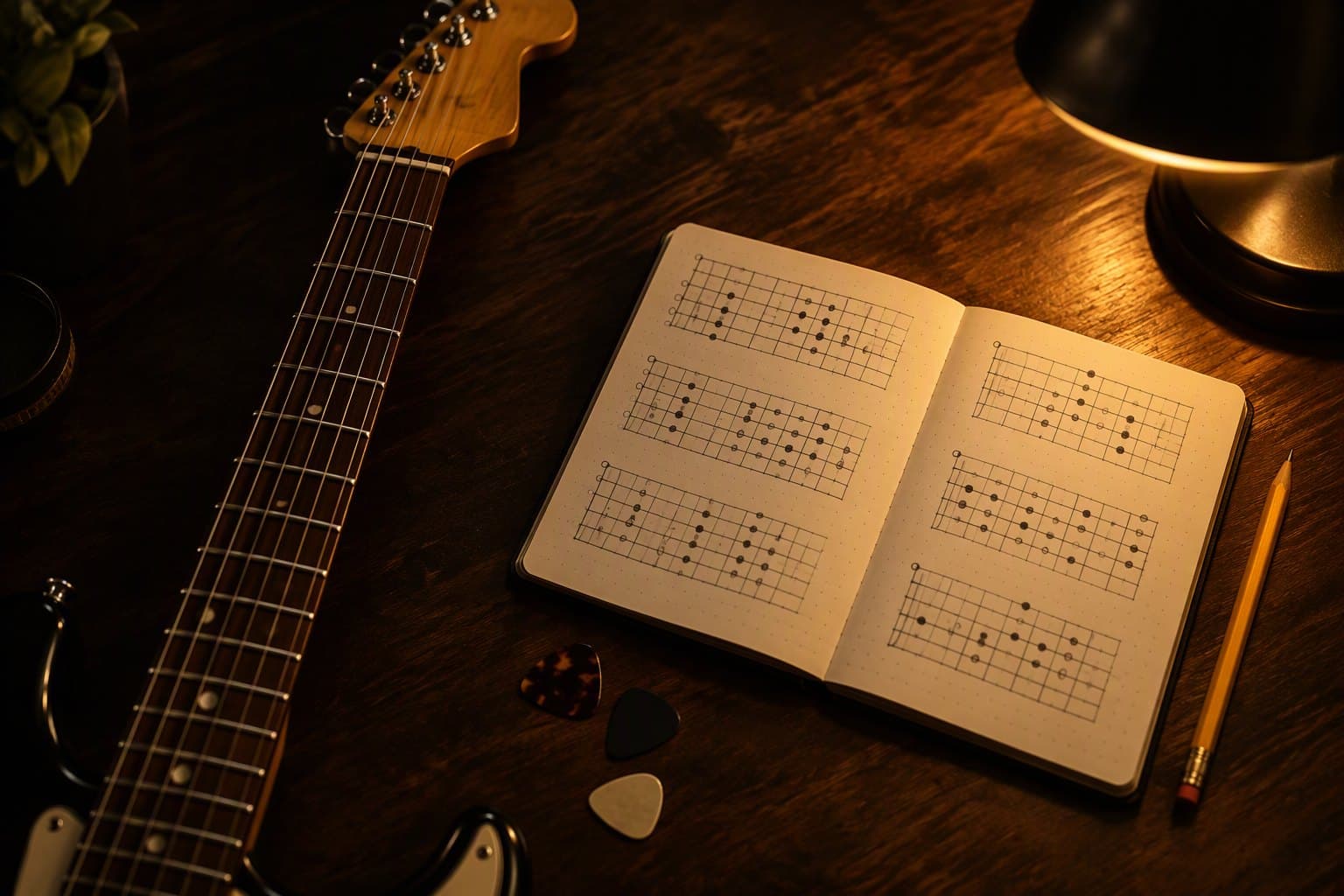
FreeMinor Pentatonic: The Boxes
Box 1
The minor pentatonic is the most-used scale in blues and rock. It has five notes: the root, minor third, fourth, fifth and flat seventh. In A minor…
 Free
FreeShuffle Boogie
Shuffle in A
The shuffle is the engine of the blues. Every beat splits into a long note and a short one: long-short, long-short. Say "DUM-da DUM-da" out loud and…
 Free
FreeRock Riffs
Single-note riffs
A single-note riff is a short, catchy line on the low strings that the whole song sits on. These riffs are in E minor, built from the E minor pentatonic…
 Free
FreeFingerpicking
Thumb and fingers
Fingerpicking splits the work: your thumb (p) plays the bass strings E, A and D, and your fingers take one string each: index (i) on G, middle (m) on B,…
 Free
FreePlay like Billy Gibbons
Unison bend
A unison bend is two strings meeting on one pitch. You fret E on the B string and bend D on the G string up a whole step until it is also an E. It is a…
 Free
FreeEffects Explained
Overdrive, distortion and fuzz
Every drive pedal does the same basic job: it pushes your signal harder than the circuit can cleanly handle, and the tops of the waveform get squashed.…
FreeFamous Tones
Comfortably Numb: the soaring solo tone
"Comfortably Numb" is on Pink Floyd's 1979 album The Wall, and David Gilmour's two solos are often named among the greatest in rock. The tone is thick…
The curriculum
FreeFoundations
Read tab, train both hands, and play your first chords and strums.
7 chapters

Technique
Bends, vibrato, legato, slides and clean speed.
5 chapters
Theory & the Fretboard
See the whole neck and know why things sound the way they do.
10 chapters
FreeGear & Tone
What every effect does, how to build a pedalboard, and how famous tones were made.
5 chapters
Blues
Shuffles, the blue note, classic licks and slow-blues feel.
6 chapters
Rock
Riffs, driving rhythm, lead licks and tapping.
5 chapters
Folk & Acoustic
Fingerpicking, Travis picking and singer-songwriter strumming.
4 chapters
Funk
Sixteenth-note scratching, ninth chords and tight single-note lines.
3 chapters
Metal
Gallops, tremolo picking, dark scales and fast runs.
3 chapters
Country
Boom-chick rhythm, pedal-steel bends and chicken pickin'.
3 chapters
Jazz
Shell voicings, the ii-V-I and your first bebop lines.
3 chapters
Play Like the Legends
Original exercises in the style of famous players.
12 chapters
One payment. Everything unlocked.
Free
- ✓ All Foundations chapters
- ✓ The first lesson of every chapter
- ✓ The Billy Gibbons guide
- ✓ Progress tracking
Full access
$9.99
one-time payment · lifetime access
- ✓ Every chapter and lesson
- ✓ Every Play Like the Legends guide
- ✓ Everything added later
One payment. No subscription. Secure checkout by Stripe.
All sales are final. Try the free lessons before you buy. Read the refund policy →
Questions
What do I get?
292 lessons in 66 chapters, from first chords to jazz and metal, with 759 tab exercises. Each exercise plays in your browser with a click and a tempo ladder, and each lesson ends with a checkpoint.
What's free?
All Foundations chapters, the first lesson of every chapter and the Billy Gibbons guide: 124 lessons. Free lessons open without an account; sign up free to track your progress.
Is it a subscription?
No. You pay once and keep access to everything, including lessons added later. Nothing renews.
Can I get a refund?
All sales are final, so try the free lessons first: no payment needed. We still refund duplicate or mistaken charges, and technical problems on our side that we can't fix.
Read the refund policy →What do I need?
A guitar, electric or acoustic, and a browser on a computer, tablet or phone. Headphones help. Nothing to install.
Which languages?
The whole course is in English, Italian, French, Spanish and Brazilian Portuguese. Switch any time from the menu.
Is it for my level?
It starts at your first chord and goes up to advanced lead playing. Practice plans come in beginner, intermediate and advanced levels, and every chapter targets one skill, so you can jump in where you are.
How do practice plans work?
Pick a plan by genre and level. Each week has a focus and a few short sessions of lessons and exercises at set tempos. Tick off sessions as you go; your progress and streak are saved.