The major scale is the "do re mi" you already know. Almost every melody, chord and other scale in this course is measured against it.
It has seven notes built from a fixed pattern of whole steps (W, 2 frets) and half steps (H, 1 fret): W W H W W W H. Start on C and you get C D E F G A B C, the white keys of a piano.
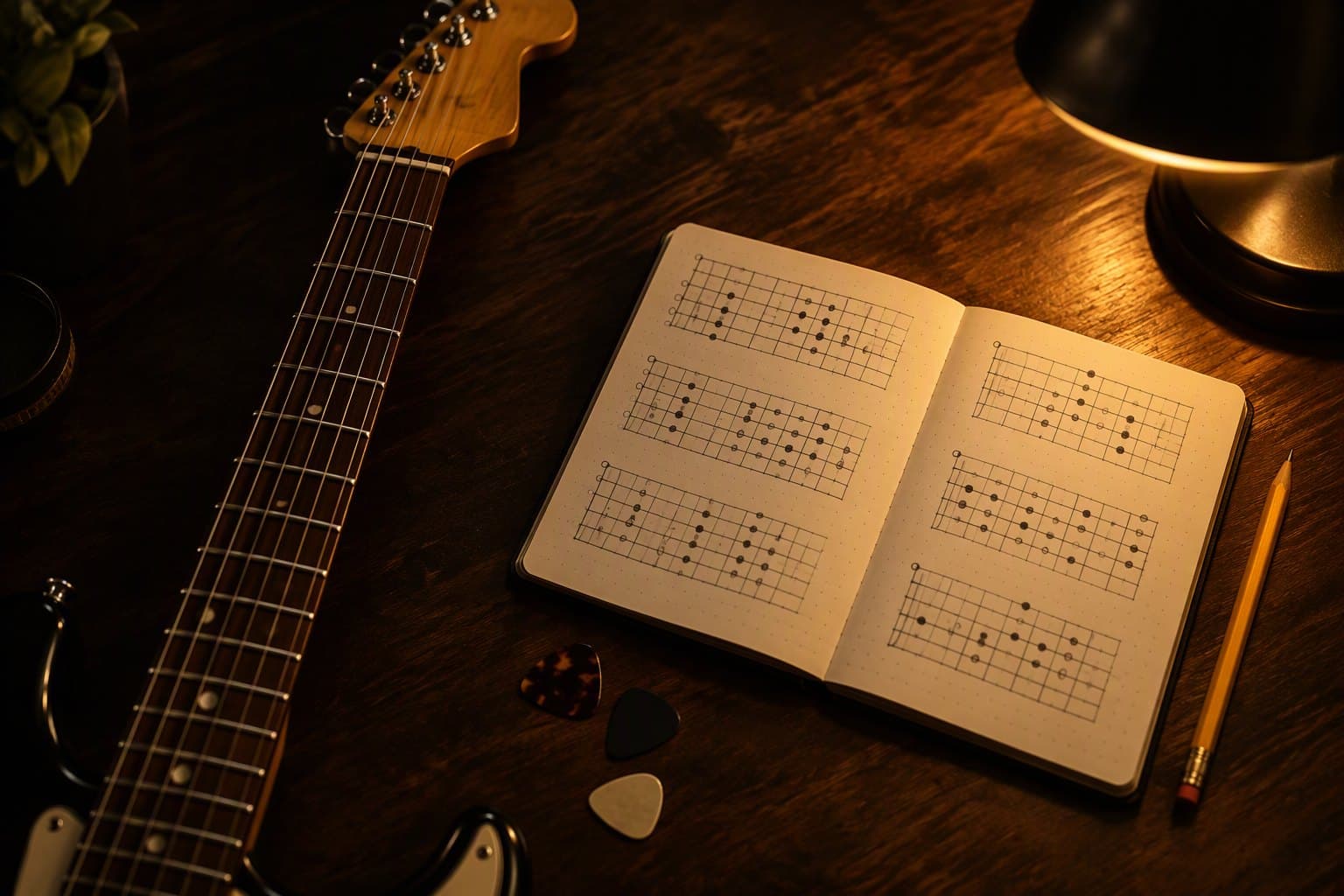
The shape
Root C on the A string at fret 3. Your hand sits in 2nd position: index finger on fret 2, middle on 3, ring on 4, pinky on 5.
- A string: C (3, middle), D (5, pinky)
- D string: E (2, index), F (3, middle), G (5, pinky)
- G string: A (2, index), B (4, ring), C (5, pinky)
Use alternate picking: down, up, down, up, even across string changes.
It should sound like "do re mi fa so la ti do", with no gaps. The half steps (E to F, B to C) feel like the notes are leaning into each other.
The common mistake is letting your hand drift and stretching with the index finger. Keep one finger per fret. Once the scale is smooth, play it in thirds: skip a note, step back, skip again. The last two exercises play the scale in groups of three and then four notes.